
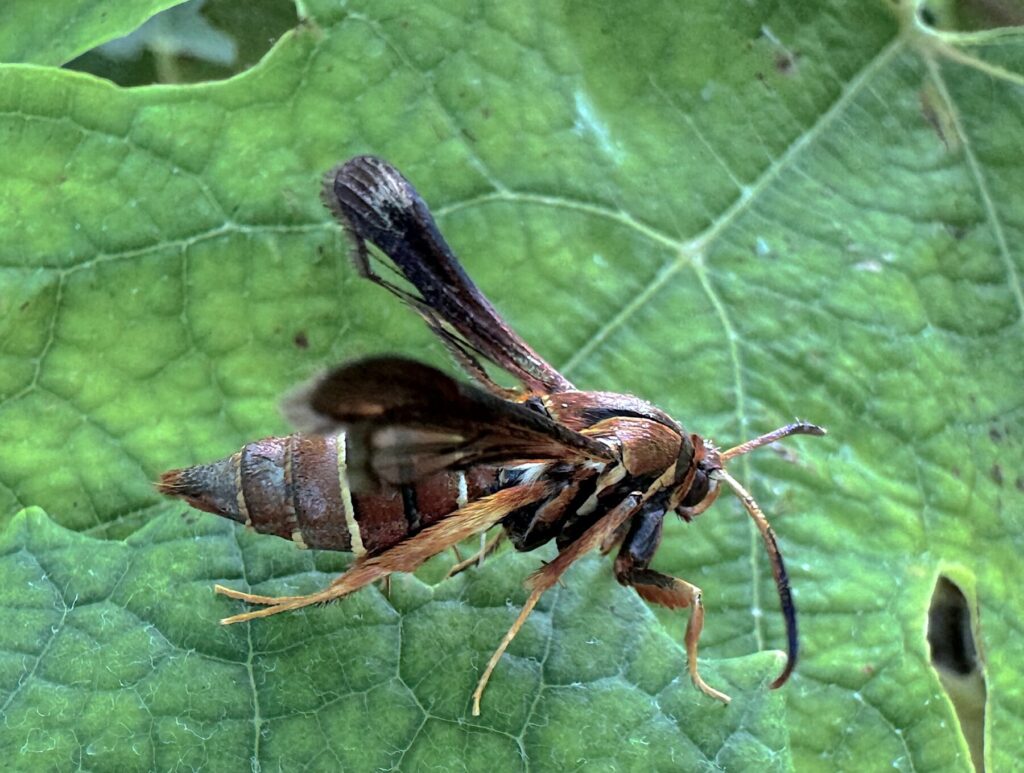
We are within a month or so of the anticipated initial emergence of grape root borer (GRB) adults here in North Georgia. We normally start to see adult emergence and activity in late June or early July. As such, if you are planning on managing for GRB, it is time to start considering your option to take care of this sneaky pest.
If you are unfamiliar with grape root borer (pictured above), GRB is a clearwing moth with larvae that tunnel into the larger roots and crown of grape vines and feed below the soil surface. Symptoms of infested vines include poor growth and fruit set, and potentially complete root girdling and vine death. As such GRB is a significantly destructive vineyard pest in southern grape production.
Adult GRB are day flying moths that are reddish brown in color and resemble paper wasps, particularly when flying. The adults generally emerge late June or early July, mate, and then the females lay eggs on the soil surface, leaves, and weeds within eight days of emerging. The eggs hatch in approximately two weeks and larvae immediately tunnel into the soil in search of grape roots. The larvae are cylindrical, cream-colored with a brown head, and 1.5 inches long when mature. The larvae spend one to two years feeding within the roots. During the summer of the second year of development, the larvae will pupate near the soil surface before emerging as adults.
MONITORING
Because the adults and the larvae often go unnoticed until the vine begins to decline, management can be a little tricky. Fortunately, GRB adults can be monitored using a simple bucket trap and pheromone (pictured above). Traps and pheromone can be purchased from sites like Great Lakes IPM* and assembly instructions can be found here. The abundance of moths captured on a weekly basis can be used to determine both presence of grape root borer in your vineyard and to determine peak activity periods, which can be used to time management activities.

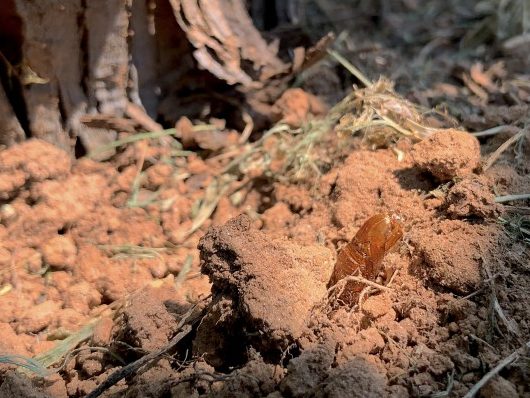
In addition, particularly in vines that have reduced vigor and/or poor fruit set, it is important to monitor the soil underneath the vines for signs of GRB infestation. As the adults emerge from the soil, they leave behind brown pupal cases protruding partially from the ground (see image below). Check the area of about 18 inches radially surrounding the base of vines. Finding the pupal cases is a good sign that the vine is infested with GRB. Keeping this area clear of vegetation will aid in detection and will potentially help with control of grape root borer by increasing the exposure of their eggs to predators and desiccation.
MANAGEMENT
One preemptive management strategy is weed control. Eliminating weeds around the base of vines reduces the sites for egg laying and improves spray coverage for GRB management.
The use of entomopathogenic nematodes to manage GRB in the soil has been quite effective. These are beneficial round worms that are able to kill soil-dwelling insects. This is a strategy that I am currently evaluating. However, commercially available species, such as Heterorhabditis bacteriophora , have been shown to effecting kill GRB larvae and are available from sources, such as Arbico Organics*. The nematodes can be applied with standard spray equipment as a drench to the base of the vines, and once in the soil, the nematodes will seek out and can kill the GRB larvae, even after they tunnel into the roots (Said et al. 2015). More information can be found in this article at the Southern Region Small Fruits Consortium.
Mounding is an alternative management strategy that involves placing mounds of dirt, approximately 10 inches deep, around the base of each of the vines mid- to late June. This basically makes it hard for the adults to emerge from under the soil and also removes the main area for the females to lay eggs. Research has shown that mounding can reduce adult emergence by up to 90% (Sarai 1969), but is labor-intensive. After August, the mounded dirt should be removed from the base of the vines.
Another highly effective management strategy is called, “mating disruption.” Through the deployment of pheromone-filled dispensers (pictured below) within your vineyard, mating disruption works by making it difficult for males to find females to mate, and without mated females, there are no new larvae to attack the vines. The entire vineyard needs to be under mating disruption for at least two years, but after two years of use, it is really effective at reducing the GRB within the vineyard.

There is a new mating disruption product, ISOMATE GRB Z*, from CBC America that has received anEPA Section-18 for Georgia for the 2026 season. As with the previous ISOMATE GRB, the new one can be purchased through Cain-Bickely Chemicals, Helena Chemical Co., or Simplot Turf & Horticulture. For more information, please check out this fact sheet from CBC America and the updated label below.

One of the key management strategies for insect pests is the use of insecticides. The key insecticide labeled for GRB was Lorsban* (chlorpyrifos), which was applied as a trunk spray. However, the EPA has proposed a new rule to revoke the tolerances of chlorpyrifos associated with all but the 11 uses, which include: alfalfa, apple, asparagus, cherry (tart), citrus, cotton, peach, soybean, strawberry, sugar beet, wheat (spring), and wheat (winter), but not grape. Additionally, nearly all of the labels for chlorpyrifos products have been cancelled. While additional chemical options are being evaluated, unfortunately, there are currently no recommended chemicals for GRB management.
There is no silver bullet for GRB and each strategy has its limitations, so if you have any questions about the management strategies discussed here, please let me know. Also, please refer to the Southern Region Small Fruits Consortium for management strategies for GRB in Georgia.

*Does not imply endorsement of named vendor or brands over other options
